
applied to Sto’s Building Materials Challenge
Our experience
We built the pieces required for an end-to-end IC program.
Over a decade, ADL developed the methods, partnerships and delivery capabilities that now support owner-controlled industrialized construction programs.
Required tasks completed.Technical goals achieved.Government acceptance documented.
2016–2019
01 / Operating method
Built a way to innovate with construction incumbents.
Nolan Browne’s TEDx talk argued that entrepreneurs cannot modernize a large, regulated industry by trying to replace its incumbents. The DOE-backed Problem Space program turned that idea into an operating method: define an industry problem, expose the requirements and organize the people capable of solving it.
What this proves
ADL’s program-development method was built for established industries where standards, assets and incumbent participation determine whether an idea can scale.
2017–2020
02 / Federal foundation
Turned the case for IC into federal program support.
The Case for Prefab, first launched in 2017 and expanded in 2019, framed industrialized construction as more than a building technique. It connected better buildings with domestic manufacturing, skilled work, economic resilience and national preparedness.
ADL then helped translate that case into the operating architecture of the DOE-funded Advanced Building Construction Collaborative: organize demand, grow supply, improve delivery and inform policy.
What this proves
ADL can move from a strategic argument to the structure of a multi-party program connecting owners, manufacturers, researchers and government.

2020–2021
03 / Open product
Rallied manufacturers around one open product.
When the pandemic created an urgent need for hospital capacity, ADL convened manufacturers and led an effort to create an open, standardized hospital-room concept that multiple factories could produce. The work helped form the Modular Mobilization Coalition.
The effort exposed the decisive issue: shared intent is not enough. Product rules, component interfaces and delivery authority must be established before a distributed supply base can perform as one system.
ADL then applied the same product-platform logic for a global hospitality company, developing a configurable kit of parts and the economics for repeated deployment.
Visit the Modular Mobilization CoalitionWhat this proves
ADL understands both sides of IC: the product an owner needs and the network of manufacturers required to deliver it repeatedly.
Qualified manufacturersOne open product
2022–2024
04 / Integrated ecosystem
Designed the ecosystem required to make IC scale.
For the National Science Foundation, ADL organized an Appalachian IC engine spanning product development, factories, workforce, applied research, policy and building demand. NSF encouraged the coalition to submit twice—an unusual opening for a construction-focused program within a science and technology initiative.
The architecture carried into funded work. In 2023, ADL won the $500,000 DOE EPIC Grand Prize to develop the Deployment Engine for hard-tech construction ventures. The Stanford IC course codified the lessons; the Industrialized Construction Summit continues building the national community around them.
What this proves
ADL can assemble the technical, commercial, workforce and institutional machinery required to move an IC market—not merely advise one participant.
Shared productRepeat demandAligned capacity
2024–today
05 / Institutional programs
Applied the full model to institutional programs.
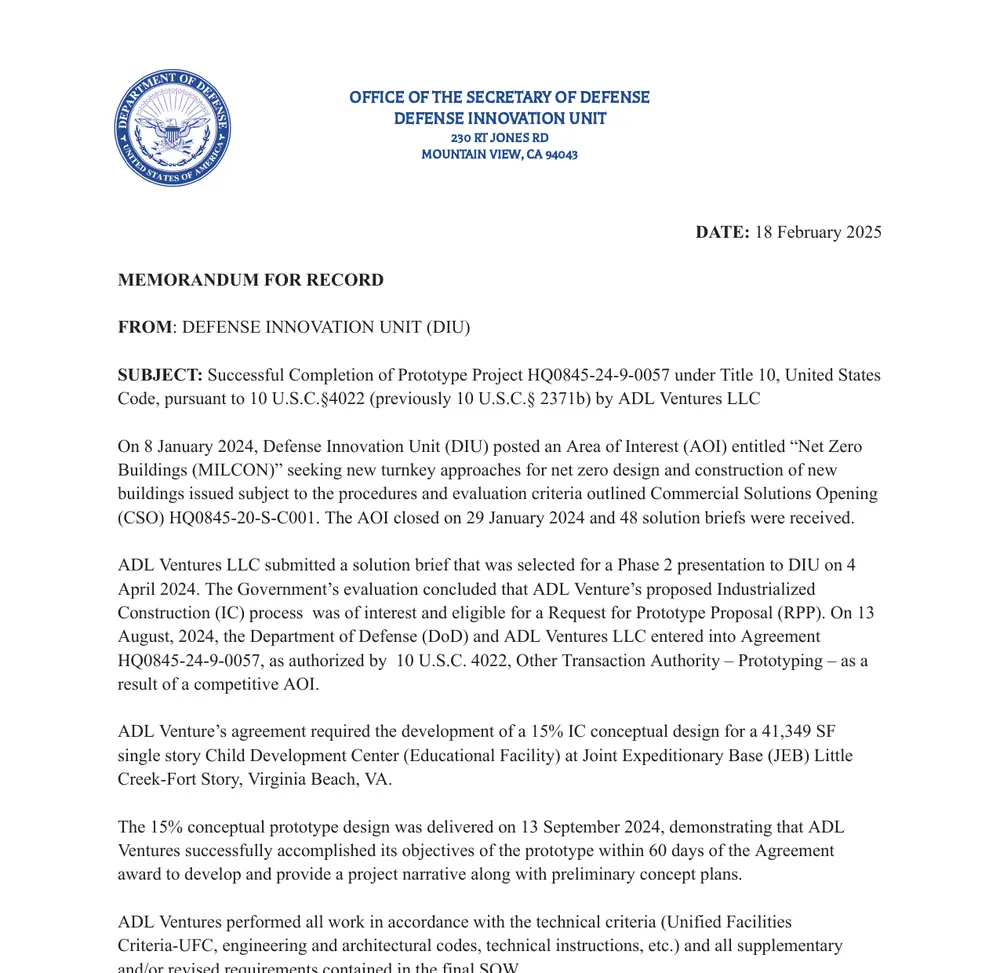
DIU selected ADL through a competitive process to develop an IC concept for a 41,349-square-foot military child-development center. ADL delivered the 15% concept design within 60 days, including plans, cost and schedule estimates, lifecycle analysis, energy modeling and an approach to standardization and prefabrication.
The February 2025 successful-completion memorandum records that ADL completed the required tasks, achieved the technical goals and performed in accordance with federal facility criteria.
Today, ADL applies that experience to institutional IC programs while helping shape the wider military playbook. Ankur Dobriyal served as a writing-group co-chair for SAME’s 2026 guide to industrialized construction opportunities for the Department of War.
What this proves
ADL can convert IC strategy into an accepted owner deliverable inside the technical, cost, schedule and compliance constraints of a major institution.
People and organizations in the work
Construction changes through collaboration.
Our published work spans materials companies, ventures, research institutions and sector conversations. Each relationship below is described by what ADL has documented.
Sto Corporation + Liatris
ADL’s ProblemSpace worked with Sto to set requirements and run an open building materials challenge. Liatris, a fire-resistant insulation venture, was selected as one of three winners.
Read the case studyRMI + research partners
ADL and RMI jointly led the DOE-funded ABC Collaborative. ADL also joined funded IC work with the University of Texas at Austin and a workforce consortium led by Virginia Tech.
Autodesk + Aeroshield Materials
Leaders from Autodesk and Aeroshield Materials joined an ADL-moderated Greentown Labs panel about how startups and established companies can work together on climate technologies.
Read the event recapThe through line
From research to real programs.
ADL’s work has connected industry collaboration, federal support, open product rules, manufacturing capacity and institutional delivery. Those experiences inform the industrialized construction programs we develop with owners today.
- 01Industry collaboration
- 02Federal mandate and support
- 03Open product rules
- 04Manufacturing and delivery ecosystem
- 05Institutional owner program
Combined capabilityEnd-to-end owner-controlled IC programOpen to qualified partners. Integrated around owner demand.
Apply the experience
Build the program your institution needs.
Start with your portfolio, establish the economics and determine what your organization must control to make IC repeatable.
Request an IC Program Assessment